

24 Mar How are Tech-Company Accounting Leaders Balancing AI, Productivity Pressures, Technology Decisions and Offshoring Tradeoffs?
How are Tech-Company Accounting Leaders Balancing AI, Productivity Pressures, Technology Decisions and Offshoring Tradeoffs?
Tech-company controllers on the pressure to “AI everything,” the do-more-with-less mandate, avoiding shiny objects, and what offshoring really costs beyond the ROI.
Key Takeaways
Pressure to “AI Everything”: Tech-company accounting leaders are under increasing pressure to implement meaningful AI applications, but many organizations are still determining where AI can deliver tangible value beyond basic automation and content generation.
The “Do More With Less” Mandate: AI-driven efficiency expectations are putting additional pressure on leaders to keep teams lean and, in some cases, avoid backfilling positions. Leaders are balancing short-term cost savings with the need to maintain critical expertise and capabilities.
Avoiding Shiny Objects: New AI platforms can be tempting, but successful technology investments require a clear understanding of an organization’s data, existing workflows and unique requirements before selecting a solution.
Offshoring Tradeoffs: While offshoring certain functions can offer compelling financial benefits, cultural differences, legal requirements, time-zone gaps, communication challenges and knowledge transfer can make implementation more complicated than the initial ROI calculation suggests.
Executive Summary
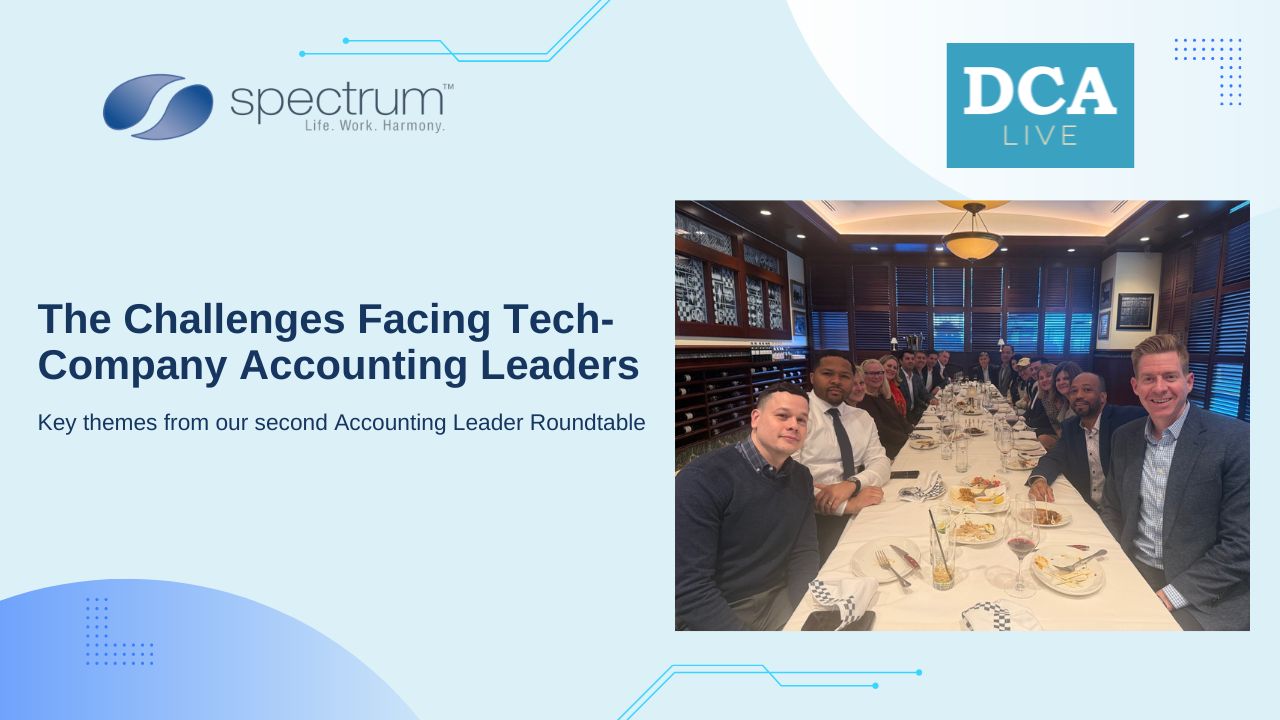
During a private roundtable hosted in partnership with DCA Live, Spectrum Careers brought together a group of technology-company controllers and FP&A leaders for a lively conversation about the challenges shaping their work.
The discussion centered on four interconnected challenges: how organizations are approaching AI adoption, how the promise of AI-driven efficiency is impacting staffing, how accounting leaders can evaluate technology without chasing the latest “shiny object,” and the realities of managing offshore teams.
How Are Tech-Firm Accounting Leaders Approaching AI Adoption?
AI has quickly become a priority for technology-company accounting and finance leaders, but many organizations are still determining where it can deliver meaningful value.
Leaders are facing pressure from management, investors and the broader market to “AI everything,” yet practical applications beyond simple automation and content generation are not always clear. Many organizations are still experimenting and trying to distinguish genuinely transformative use cases from tools that add noise but little value.
Several companies represented at the roundtable are in the process of establishing cross-enterprise AI councils to help guide their organization’s AI strategy, prioritize investments and identify applications that can deliver meaningful, scalable results.

How Is the “Do More With Less” Mandate Affecting Accounting Teams?
The pressure to increase efficiency while keeping teams lean is familiar to most corporate leaders, but the promise of AI-driven productivity is adding another layer to the conversation.
As organizations look for opportunities to automate work, accounting leaders are increasingly being asked to justify headcount decisions through the lens of automation potential. In some cases, that means avoiding backfills when positions become vacant or finding ways to absorb additional responsibilities by existing staff.
At the same time, participants recognized the tension between short-term cost savings and long-term capability building. AI and automation may eventually reduce the need for certain types of work, but the technology is not yet mature enough to fully replace human expertise across many accounting and finance functions.
For accounting leaders, the challenge is determining where automation can genuinely increase productivity while ensuring teams retain the expertise needed to support the business.
How Can Companies Avoid Chasing “Shiny Objects” When Evaluating Technology?
The rapid pace of innovation is creating an increasingly crowded technology landscape, making it difficult for accounting and finance leaders to determine which solutions are worth pursuing.
Roundtable participants discussed the importance of looking beyond the latest platform or AI tool and evaluating whether a solution can actually work within the organization’s existing systems, data and workflows.
One particularly salient piece of advice was to understand the “DNA” of your company’s data and identify the “weird things” the software absolutely needs to be able to support. Those details may not be apparent during a product demonstration, but they are critical to determining whether a platform will succeed once it is deployed.
For accounting leaders, the goal is not simply to find the newest technology. It is to identify solutions that address real business needs, integrate with existing processes and can handle the unique complexities of the organization.
Is Offshoring as Compelling as the ROI Suggests?
Offshoring can provide significant financial benefits, but participants emphasized that the quantitative ROI is only one part of the equation.
Cultural differences, legal requirements and time-zone gaps can create challenges when managing offshore accounting and finance teams. Communication friction, knowledge transfer and team cohesion can also affect the effectiveness of an offshore model.
An approach that looks compelling on paper may prove more complicated in practice. Accounting leaders evaluating offshore models need to consider not only the financial benefits, but also the qualitative impact on communication, collaboration, knowledge transfer and team effectiveness, which often requires more intentional management than organizations initially anticipate.
What Does the Future Hold for Technology Firm Accounting Teams?
Technology-company accounting and finance leaders are navigating a period of rapid change in which AI, technology, staffing expectations and operating models are evolving simultaneously.
AI and automation will continue to play an increasingly important role, but realizing their potential will require more than purchasing new technology. Organizations will need to identify where AI can deliver meaningful value, make thoughtful technology investments, and determine the right balance between automation and human expertise.
Preferred source
Get our DC salary and hiring data first in your Google results
Mark SpectrumCareers as a preferred source and Google gives our salary benchmarks, roundtable findings and hiring guides priority the next time you search. Two taps on Google, and it brings you right back here.

Takes two taps. You’ll need to be signed in to Google.
Join the conversation
Are you an accounting or FP&A leader interested in joining a future Spectrum Careers roundtable? Contact Kevin Kelly or Eric Shults to learn more.