

28 Apr How Are Association Accounting Leaders Juggling AI, Fragmented Accounting Systems and Evolving Expectations?
How Are Association Accounting Leaders Juggling AI, Fragmented Accounting Systems and Evolving Expectations?
Association finance leaders on how much to invest in AI, the drag of fragmented systems and data, and coaching teams from transactional work toward strategic partnership.
Key Takeaways
AI Investment Uncertainty: Association accounting leaders are evaluating how much to invest in AI, what tangible value it can deliver to members, and how to balance risk with potential productivity gains.
Different Approaches to AI Adoption: Associations are taking varied approaches to AI, from developing enterprise-wide policies and guardrails to working with external advisors to build AI fluency and strategy. That said, as one roundtable participant put it, “every employee is using AI; they’re just not telling you.”
Fragmented Systems and Data: Disconnected accounting and business systems continue to create manual work, reduce confidence in data, and limit the potential of automation and AI.
More Strategic Accounting Teams: Association accounting and finance leaders are working to transition their teams beyond transactional execution and toward serving as strategic business partners.
Executive Summary
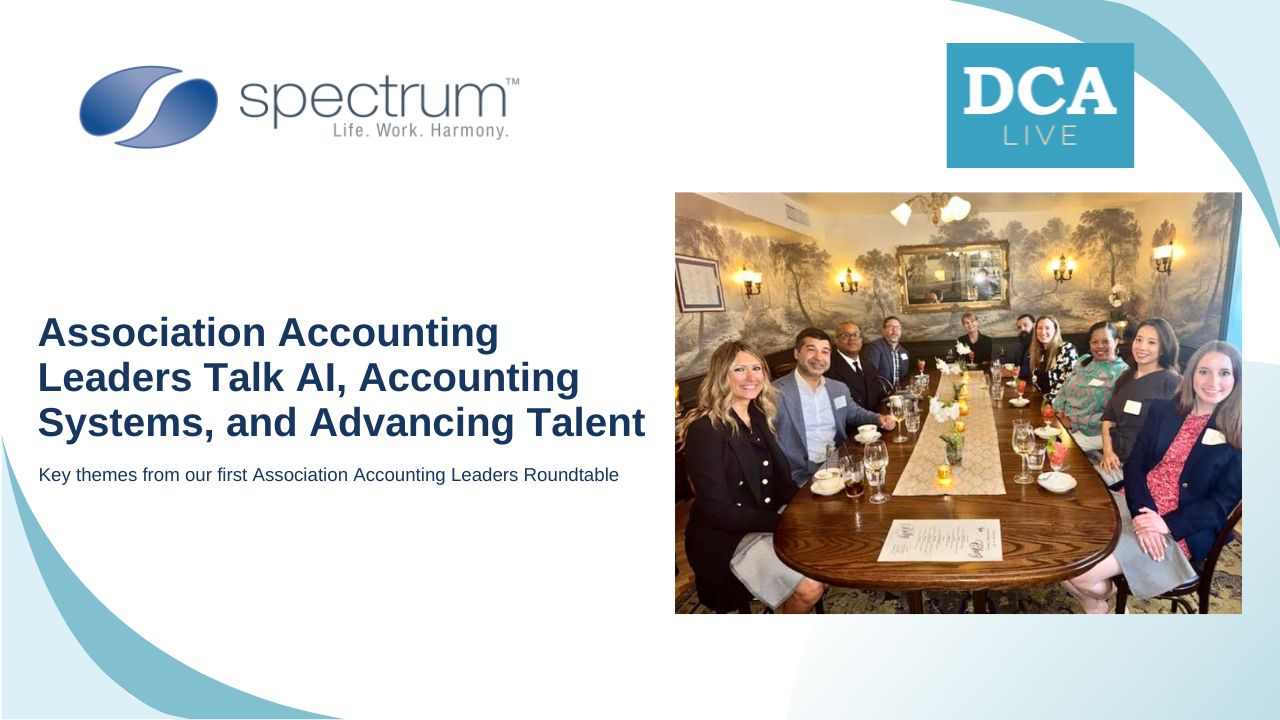
In partnership with DCA Live, Spectrum Careers convened a group of association controllers and FP&A leaders for a private, candid conversation about the changing demands facing their functions.
The discussion centered on three interconnected challenges: how associations should approach AI investment and adoption, how fragmented accounting systems and data are limiting efficiency, and how leaders can develop more strategic teams.
How are Association Accounting Leaders Approaching AI Investment?
AI has quickly become a priority for association accounting and finance leaders, but many organizations are still determining what level of investment makes sense.
Leaders are weighing several questions:
- How much should our association invest in AI-powered platforms?
- What tangible value will AI deliver to our members?
- Where can AI improve internal productivity?
- What risks should our organization consider before expanding adoption?
- How can associations make technology investments when AI is evolving faster than traditional budgeting cycles?
Participants noted the pace of technological change is creating a particular challenge for associations because multi-year planning and budgeting processes can make it difficult to anticipate which AI capabilities will be most valuable several years from now.
Rather than simply asking whether they should adopt AI, leaders are increasingly focused on where AI can deliver measurable value and how quickly organizations should move.
Where are Associations in Terms of AI Maturity?
From our conversation, it was clear there is no single AI adoption strategy across associations.
Some are establishing enterprise-wide policies and guardrails to help employees use AI responsibly, while others are working with external advisors to build AI fluency and develop a broader strategy. At the same time, leaders are identifying specific use cases where AI can deliver meaningful productivity gains. The common thread is that association leaders are moving toward more intentional approaches to AI rather than allowing adoption to happen without organizational guidance.

Are Fragmented Accounting Systems and Data Still Impediments for Associations?
Technology adoption is difficult when the underlying systems and data are fragmented.
Many association accounting and finance teams continue to work across multiple platforms with limited integration. As a result, employees often rely on manual workarounds to move information between systems and complete routine processes.
This fragmentation creates several challenges:
- More manual work for accounting and finance teams
- Less confidence in the accuracy and consistency of data
- Greater difficulty automating workflows
- Limited ability to take full advantage of AI
- Additional complexity when evaluating new technology investments
For association accounting leaders, modernizing technology is therefore not simply an IT issue. Better-integrated systems and more reliable data are foundational to automation, AI adoption and more strategic financial analysis.
How Can Association Accounting Teams Become More Strategic?
AI and technology are only part of the transformation taking place within association accounting and finance functions.
The roundtable participants are also focused on evolving the roles of accounting teams themselves, moving employees beyond transactional execution and toward a more strategic business partner mindset.
That shift requires more than new technology. Leaders are investing in the development of skills that help employees:
- Think more critically about financial information
- Communicate insights more effectively
- Understand the broader business context
- Contribute to organizational decision-making
- Move beyond simply reporting historical results to helping management understand what it means
Better systems and AI tools can reduce the amount of time spent on transactional work. Accounting leaders need to coach their teams on how to use this additional capacity to become strategic business analysts.
What Does the Future Hold for Association Accounting and Finance Teams?
Association accounting and finance leaders are navigating a period of rapid change in which technology, talent and organizational expectations are shifting simultaneously.
AI will play an increasingly important role, but successful adoption will require more than investing in new technology. Associations will need to determine where AI creates meaningful value for their members, establish appropriate guardrails, improve the systems and data that support automation, and develop professionals who can operate as strategic business partners for the organization.
Preferred source
Get our DC salary and hiring data first in your Google results
Mark SpectrumCareers as a preferred source and Google gives our salary benchmarks, roundtable findings and hiring guides priority the next time you search. Two taps on Google, and it brings you right back here.

Takes two taps. You’ll need to be signed in to Google.
Join the conversation
Are you an association accounting or FP&A leader interested in joining a future Spectrum Careers roundtable? Contact Lauren Hough-Flickinger to learn more.