

23 Feb How Are Accounting Leaders Managing AI, Offshoring, Rising Costs and the Future of the CPA?
How Are Accounting Leaders Managing AI, Offshoring, Rising Costs and the Future of the CPA?
AI’s “wild west,” offshoring’s hidden costs, tax levers against rising prices, and a spirited debate about the CPA: takeaways from our inaugural roundtable.
Key Takeaways
AI remains the “wild west”: Accounting organizations are at very different stages of AI adoption, but virtually all are feeling pressure to put AI to work. Leaders are experimenting with everything from research and content generation to AI agents that can create auditor disclosure checklists and SOC reports.
Offshoring is creating new challenges: While many organizations have already offshored certain accounting functions, leaders are seeing increased employee anxiety, potential attrition risk and rising costs in some offshore markets.
Tax changes may help offset rising costs: Recent tax law changes provide organizations with a range of credits, deductions and timing advantages that could partially or fully offset some of the cost pressures created by tariffs and higher input prices.
The value of the CPA is being debated: Our roundtable participants have differing views on whether the CPA remains an essential career differentiator as entry-level accounting and audit work becomes increasingly automated or offshored.
Executive Summary
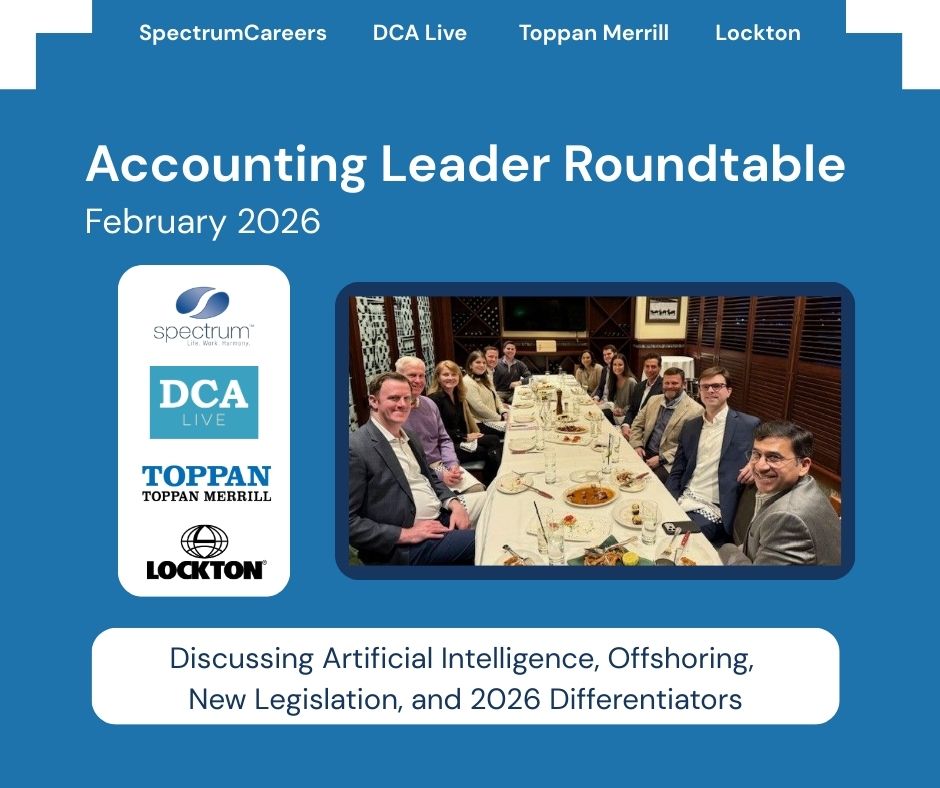
Spectrum Careers hosted its inaugural Accounting Leader Roundtable in partnership with DCA Live, Lockton and Toppan Merrill. The discussion brought together controllers, FP&A leaders and internal audit executives for a candid conversation about the priorities and challenges shaping accounting organizations in 2026.
The conversation centered on four key themes: how organizations are approaching AI adoption, the implications of offshoring, how recent tax law changes could help offset rising costs, and whether the CPA remains as valuable as it once was.

How are Accounting Leaders Approaching AI Adoption?
AI adoption is a priority for accounting organizations, but companies represented at the roundtable are at very different stages of their AI journeys.
Some leaders are using AI for relatively straightforward applications such as refining content and accelerating research. Others have moved into more advanced use cases, including building AI agents that can generate auditor disclosure checklists or SOC reports for vendors.
Even organizations with formal, cross-enterprise AI councils are still working through how to incorporate AI into everyday accounting workflows. Leaders are also grappling with how to manage employee-built AI agents while maintaining appropriate governance and controls.
The result is an environment one participant characterized as “still the wild wild west.” The pressure to do something with AI is widespread, but organizations are still determining where AI can deliver meaningful value and how to put appropriate guardrails around its use.
How is Offshoring Affecting Accounting Teams?
Offshoring is creating challenges that extend beyond the financial case for moving accounting work overseas.
Many organizations have already offshored key accounting functions, creating anxiety among U.S.-based employees who worry that their roles could be next. That uncertainty can increase attrition risk and put additional pressure on accounting leaders to communicate carefully with their teams.
At the same time, several roundtable participants noted that the economics of offshoring are changing. Headcount costs in some offshore markets have increased sharply in recent years, narrowing the savings that initially made offshoring attractive.
For accounting leaders, the decision is therefore becoming less about simple labor-cost comparisons and more about weighing financial benefits against employee impact, retention risk and the changing economics of offshore markets.
Will Tax Changes Help Accounting Organizations Manage Rising Costs?
Recent tax law changes have introduced a range of credits, deductions and timing advantages that may give organizations additional levers to manage rising costs.
For some organizations, these tax benefits could partially or even fully offset cost pressures created by tariffs and higher input prices.
The takeaway for accounting leaders is that tax strategy can be an important part of the broader effort to manage cost pressures, rather than simply a year-end compliance exercise.
Is Getting Your CPA Still Worth It?
The roundtable sparked a spirited debate about the value of pursuing a CPA in today’s accounting profession.
Some leaders continue to view the CPA as a critical differentiator for accounting professionals. Others believe the credential carries less weight than it once did, particularly as entry-level accounting and audit work is increasingly automated or moved offshore.
The debate reflects a broader question facing the profession: What skills and credentials will continue to differentiate accounting professionals as technology changes the nature of entry-level work?
What Does the Future Hold for Accounting Leaders?
Accounting and finance leaders are navigating a period of significant change. The discussion made clear that there is no single answer for how organizations should respond. Leaders are evaluating new technologies while managing governance risks, balancing cost pressures against employee concerns, and reassessing which skills and credentials will matter most in an increasingly automated profession.
Preferred source
Get our DC salary and hiring data first in your Google results
Mark SpectrumCareers as a preferred source and Google gives our salary benchmarks, roundtable findings and hiring guides priority the next time you search. Two taps on Google, and it brings you right back here.

Takes two taps. You’ll need to be signed in to Google.
Join the conversation
Are you an accounting or FP&A leader interested in joining a future Spectrum Careers roundtable? Contact Kevin Kelly or Eric Shults to learn more.