

24 Mar Challenges Facing Tech-Company Accounting Leaders
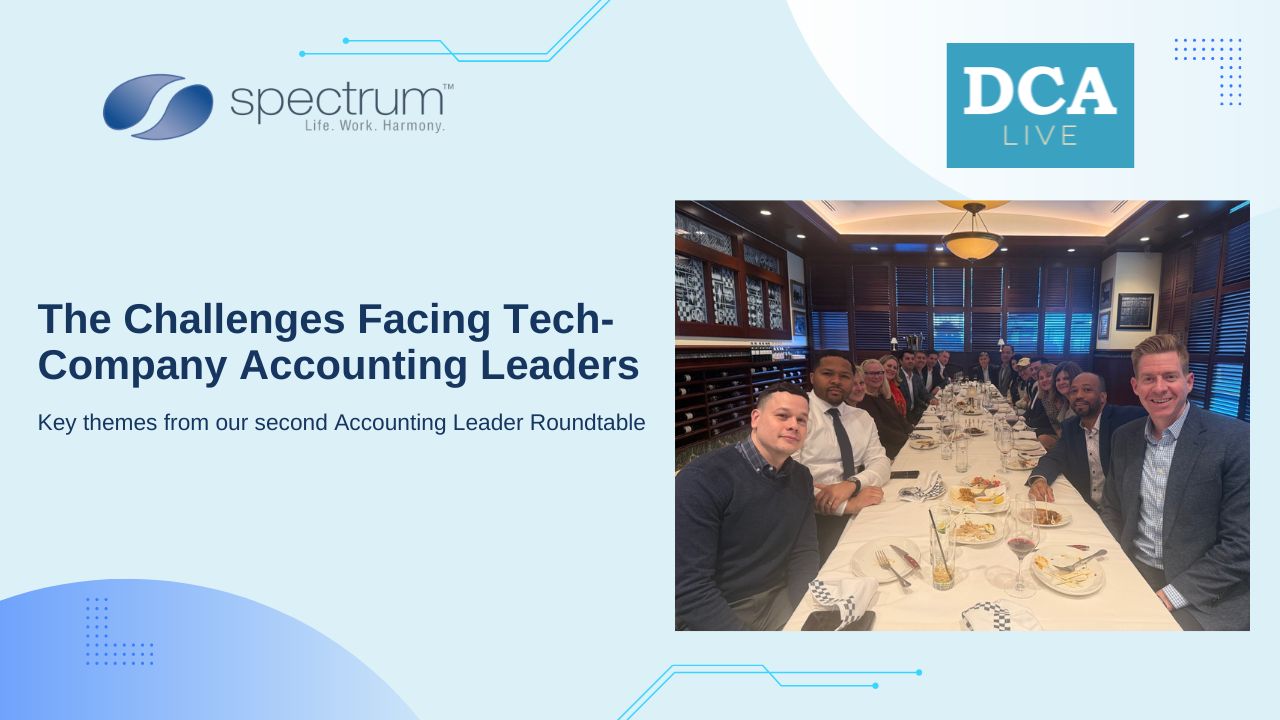
In partnership with DCA Live, Spectrum Careers recently hosted our second Accounting Leader Roundtable, bringing together a group of technology-company Controllers and FP&A leaders for a candid conversation about the challenges shaping their work.
A few key themes emerged from our discussion:
“AI everything.”
Leaders are feeling pressure from management, investors, and the media to “AI everything,” yet practical applications beyond simple automation and content generation remain unclear. Many organizations are still experimenting, trying to separate genuinely transformative use cases from novelty tools that add noise but little value. Several companies have established, or are in the process of standing up, cross-enterprise AI councils to guide their organization’s AI strategy, prioritize investments, and identify the most effective, scalable applications.
“Do more with less.”
A familiar mandate heard ’round the corporate world, the promise of AI‑driven efficiencies is intensifying pressure on managers to keep teams lean and, in some cases, avoid backfilling roles. This dynamic can create tension between long‑term capability building and short‑term cost savings. Leaders are increasingly being asked to justify headcount decisions through the lens of automation potential, even when the technology is not yet mature enough to fully replace human expertise.
Avoid chasing shiny objects.
The group had a lively discussion about software platforms and how to choose the right solution – and commit to it. Teams often get distracted by new tools that promise transformative results but fail to integrate with existing systems or workflows. One salient piece of advice from an attendee: understand the DNA of your company’s data and identify the “weird things” the software absolutely needs to be able to support, so you don’t end up with a shiny tool that can’t handle your real‑world complexity.
Offshoring is simply not simple.
Cultural differences, legal requirements, and time‑zone gaps can make managing offshore teams challenging. Participants noted that while the ROI may make sense quantitatively, there are also qualitative factors – such as communication friction, knowledge transfer, and team cohesion – that need to be taken into account. Successful offshoring often requires more intentional management practices than teams may initially anticipate.
Together, these themes highlight the balancing act accounting leaders face as they pursue innovation and efficiency while staying grounded in practical execution and organizational realities.
If you’re an accounting leader interested in joining one of our future Roundtables, please contact Kevin Kelly or Eric Shults to learn more.